
When a homeowner is about to spend several thousand dollars on a new kitchen countertop, they do not just want a good price — they want proof they can trust you in their home. Long before they call, they pull up your Google Business Profile and read your reviews. The shop with a steady stream of recent, glowing, detailed reviews wins the call. The shop with eight reviews from two years ago gets skipped, no matter how good its work.
Reviews are the single biggest conversion lever a countertop business has, and one of the most powerful drivers of where you rank in the Map Pack. Yet most fabricators leave them to chance. This guide gives you the exact ask system, timing, templates, and response strategy to build a reliable flow of 5-star reviews that ranks you higher and books more high-value jobs.
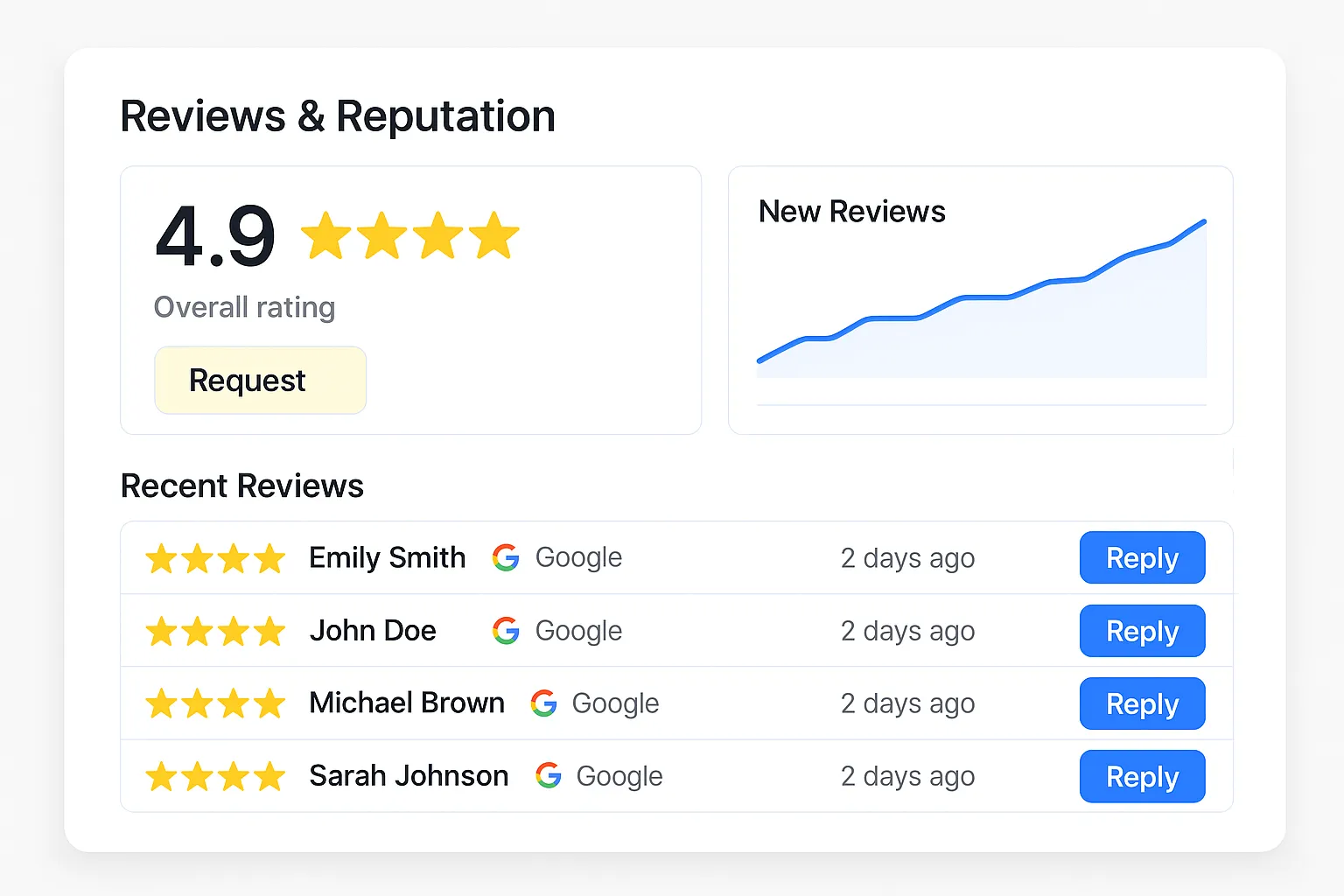
Why reviews decide who gets called
Reviews do two jobs at once, which is what makes them so valuable. First, they drive ranking: Google weighs the quantity, quality, recency, and keyword content of your reviews when deciding which three businesses to show in the local pack. Second, they drive conversion: once you do show up, the shop with more and better reviews gets the click and the call.
So a strong review engine compounds — it earns you more visibility and then converts more of that visibility into booked measures. For a considered, high-trust purchase like stone, that social proof is often the deciding factor between you and the competitor next door. The data backs it up.
The conclusion is simple: reviews are not a vanity metric, they are revenue. The shops that treat them as a system — not an occasional afterthought — win both the algorithm and the homeowner. Here is how to build that system.
Build a review ask system
The number one reason countertop shops do not get reviews is simple: they do not consistently ask. A happy customer who is not prompted almost never thinks to leave one. The fix is to make asking an automatic part of every job, so it happens without anyone having to remember.
- Make the ask a required step in your install checklist — the job is not "done" until the request is sent.
- Decide who asks (the lead installer is ideal) and what they say, so it is consistent every time.
- Use a direct review link or QR code so leaving a review takes 20 seconds, not five minutes.
- Follow the in-person ask with a text containing that link — most reviews get written on a phone.
- Track who has been asked in your CRM so no happy customer slips through.
Quick win
Create a short Google review link (or a QR code on a leave-behind card) and save it as a text template on your install crew's phones. The easier you make it, the higher your response rate — friction is the enemy of reviews.
Timing: when to ask for the review
Timing changes everything. The best moment to ask is right after the install, when the homeowner is standing in their kitchen admiring the new surface and the emotional high is at its peak. Wait a week and that feeling fades, life gets busy, and your response rate drops sharply.
- Ask in person the moment the customer expresses they love the result.
- Send the follow-up text with the link within 24 hours of completion.
- If there is no response, one gentle reminder a few days later is fine — do not nag beyond that.
- For larger or designer-led projects, a quick thank-you call before the ask warms it up.
Templates that get a yes
Keep your ask warm, specific, and effortless. Here are simple templates you can adapt. Always include the direct link so the next step is one tap.
In-person ask: "I'm so glad you love it. Reviews are huge for a local shop like ours — would you mind leaving a quick one on Google? I'll text you the link right now so it takes a few seconds."
Follow-up text: "Hi [Name], it was a pleasure installing your new [quartz/granite] countertops! If you have 30 seconds, a quick Google review would mean the world to our small team: [link]. Thank you!"
Email version: "Hi [Name], thank you for choosing us for your kitchen remodel. We'd be grateful if you'd share your experience in a short Google review — it helps other homeowners find us. Here's the direct link: [link]."
Notice what these never do: offer an incentive. Paying for or rewarding reviews violates Google's policies and can get your reviews removed. Great work plus a friendly ask is all you need.
Turn reviews into booked jobs on autopilot
We set up review-request automation, reputation monitoring, and the systems that tie your 5-star reputation to real revenue. Book a free growth call and we'll map it out for your shop.
Schedule a Free AppointmentResponding to every review
Collecting reviews is only half the work — your responses are part of the show. Prospects read how you reply, and Google rewards active engagement. Make it a rule to respond to every single review, positive or negative, within a day or two.
- Thank positive reviewers by name and reference the specific project ("your new Calacatta island").
- Naturally include a keyword or two ("granite countertop install in [city]") to support local SEO.
- Keep replies warm and human — avoid copy-paste responses that read like a robot.
- Reinforce a value or differentiator: clean seams, on-time install, exclusive attention to each client.
Handling negative reviews the right way
A negative review feels like a gut punch, but how you respond can win more trust than the review costs you. Every future prospect is watching to see whether you handle problems with grace. Never argue or get defensive.
- Respond quickly, stay calm, and thank them for the feedback.
- Acknowledge the specific concern without admitting fault you do not own.
- Move it offline: "I'd like to make this right — please call me directly at [number]."
- Once resolved, many customers will update or remove the review on their own.
Counterintuitively, a profile with a few thoughtfully handled critical reviews often converts better than a suspiciously perfect one — it reads as real.
Recency beats volume
A shop with 40 reviews and three new ones this month outperforms a shop with 120 reviews where the newest is a year old. Buyers and Google both favor freshness, which is exactly why a per-install ask system beats a one-time review drive.
Impact on rank and conversion
When you run a consistent review engine, two things improve together. Your Map Pack ranking climbs because Google sees a steady flow of recent, keyword-rich, high-quality reviews — a strong local signal. And your conversion rate climbs because the homeowners who now see you also see the proof they need to choose you.
That is the compounding effect: more visibility multiplied by a higher close rate equals far more booked jobs from the same marketing spend. It also helps you escape the price war — a shop with a wall of glowing reviews can command premium pricing, because buyers are paying for confidence, not just countertops.
Making it a habit
Reviews are not a campaign you run once — they are a habit you build into every job. Decide who asks, when, and how; make leaving a review effortless with a direct link; respond to every review like a prospect is reading; and handle the rare negative one with professionalism. Do that on every install, and your reputation becomes a durable, compounding asset that ranks you higher and books more premium work.
That is exactly the kind of reputation system we build for countertop shops — automated requests, monitoring, and responses tied directly to revenue, never to vanity metrics.