
Picture a homeowner in your city searching "quartz countertop installers near me." Before the map, before the regular ads, before a single organic result, Google shows a short list of local pros with a green Google Guaranteed checkmark, a star rating, and a "Call" button. That premium spot is a Local Service Ad — and for countertop installers, it may be the single most efficient way to turn high-intent searches into booked measures.
Unlike traditional pay-per-click, Local Service Ads charge you only when a real homeowner contacts you. And unlike shared lead services, those contacts come straight to your business — not resold to four competitors who then undercut your price. This guide breaks down exactly how LSAs work for stone shops, how to set them up, and why they beat the lead-broker model that keeps so many fabricators stuck in a price war.
What are Google Local Service Ads?
Local Service Ads (LSAs) are a separate ad format from the usual Google search ads. Instead of writing ad copy and bidding on keywords, you create a verified profile, and Google matches you to nearby homeowners searching for the services you offer. Your ad displays your business name, star rating, number of reviews, hours, and that all-important Google Guaranteed badge.
The key differences that matter for a countertop shop:
- They appear above the Map Pack and standard search ads — the most valuable spot on the page.
- You pay per lead (a call or message from a real prospect), not per click.
- Your ranking is driven by reviews, responsiveness, proximity, and verification — not by who bids highest.
- Leads come to you directly and are not shared with competing fabricators.
In short, LSAs reward the things a good fabricator already does well: showing up, doing great work, and collecting reviews. That makes them a natural fit for shops that want more high-value retail jobs without depending on builders or big-box referrals.
The Google Guaranteed badge and why it converts
The green Google Guaranteed checkmark is the heart of the LSA program. To earn it, Google verifies your business license and insurance and runs a background check. Once approved, the badge appears on your ad and tells homeowners that Google has vetted you and stands behind the work — including a money-back guarantee up to a coverage limit if a customer is unhappy with a qualifying job.
For a $4,000 to $8,000 countertop purchase, that trust signal matters enormously. A homeowner choosing between an unbadged listing and a Google Guaranteed shop with a 4.8-star rating will call the guaranteed shop nearly every time. The badge does part of your selling before the phone even rings, which is why LSA call rates often beat ordinary paid search.
Verification is a moat, not a hassle
The license, insurance, and background checks feel like extra paperwork, but they work in your favor. They keep unlicensed, fly-by-night competitors out of the LSA results — so the shops you compete against are legitimate, and homeowners already trust the format before they reach you.
How pay-per-lead pricing works
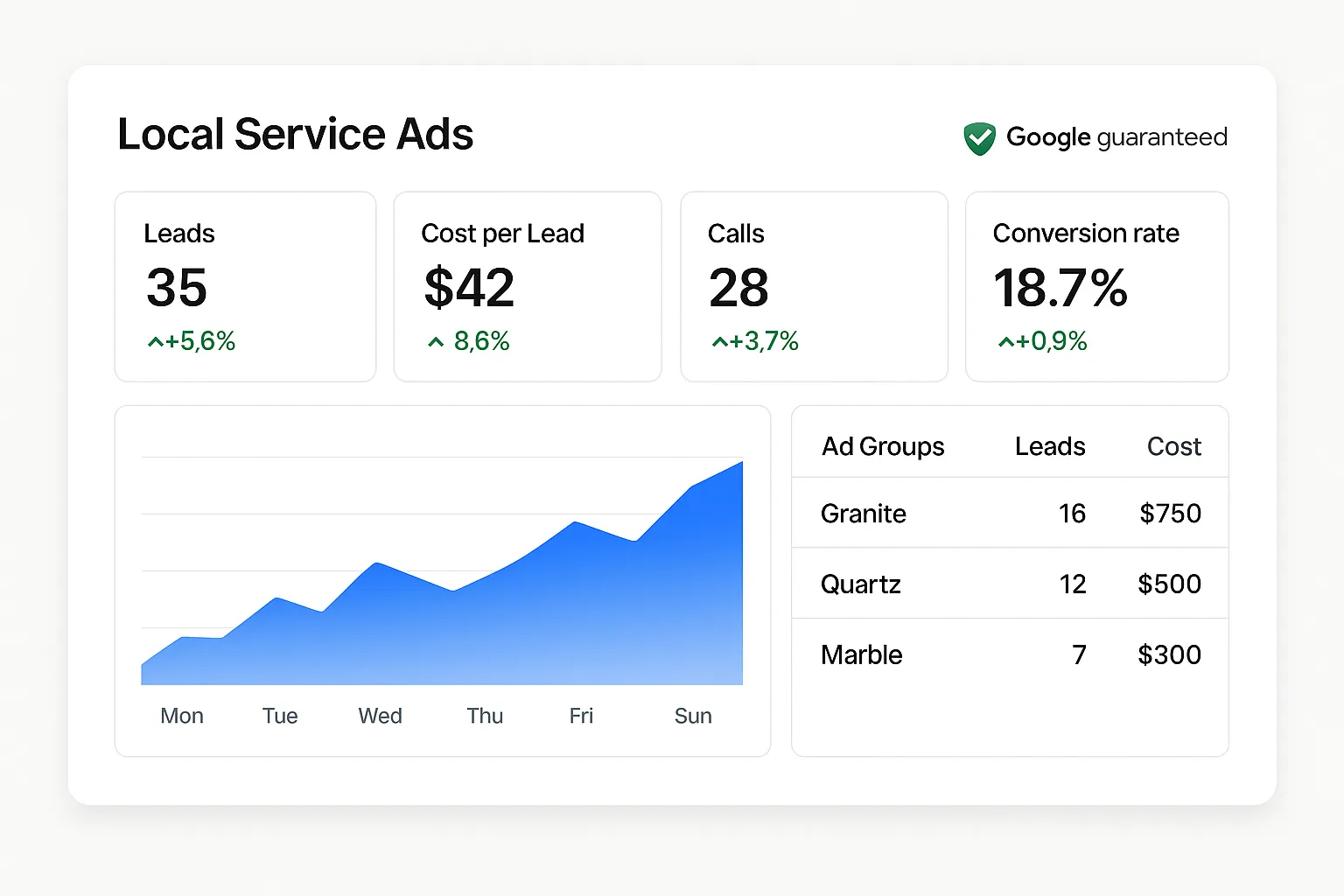
With traditional Google Ads you pay every time someone clicks, whether or not they ever contact you. Local Service Ads flip that: you are charged only when a homeowner actually calls, messages, or books through the ad. For countertop trades the cost per lead commonly falls in the range of roughly $20 to $60, depending on your market and competition.
You stay in control of spend with a few simple levers:
- Set a weekly budget and a target number of leads — Google paces delivery to match.
- Define your service area by zip code so you only pay for leads you can actually serve.
- Choose the job types you want, so a marble shop is not paying for tile-only requests.
- Dispute leads that are clearly out of area, spam, or for services you do not offer — Google credits valid disputes.
Because you can recover charges for bad-fit leads, a well-managed LSA account keeps your true cost-per-booked-job far lower than the sticker price of any single lead. That is the metric that actually matters: not what one lead costs, but what a closed countertop job costs you in marketing.
Want LSAs set up the right way?
We handle verification, profile optimization, lead disputes, and review growth so your Local Service Ads deliver exclusive, profitable countertop leads. Book a free growth call to see what your market looks like.
Schedule a Free AppointmentSetting up Local Service Ads step by step
Getting live takes some upfront work, but most of it is one-time. Here is the path a countertop installer follows:
- Create your Local Services profile and select the right job categories — countertop installation, granite, quartz, and related services.
- Define your service area by the zip codes you genuinely cover, so you only pay for reachable leads.
- Submit license and insurance documents and complete the background check to earn the Google Guaranteed badge.
- Connect your reviews — your Google Business Profile reputation feeds directly into LSA ranking and trust.
- Set your budget and lead target, then turn on the ad.
- Build a fast response process so every lead is answered in minutes, not hours.
The verification stage is where many shops stall — documents get rejected for small mismatches. Getting the details right the first time is the difference between launching this week and waiting a month.
Track every lead
LSAs come with built-in call recording and a lead inbox, but pull those leads into a simple CRM too. When you know which leads booked and which did not, you can dispute the duds, coach your phone answering, and prove a real return on every dollar — instead of guessing.
How to win more jobs from your LSA leads
Showing up is only half the battle. The shops that get the most out of Local Service Ads treat the leads like the warm, high-value opportunities they are:
- Answer in under five minutes. Speed-to-lead is the biggest predictor of who books the job — and Google rewards responsive advertisers with more impressions.
- Keep reviews fresh. Request a review after every install; recent, high ratings push you up the LSA rankings.
- Dispute bad leads promptly. Out-of-area or wrong-service requests should be credited back, protecting your cost-per-job.
- Maintain your hours and responsiveness. Profiles that respond quickly and stay active simply show more often.
Putting Local Service Ads to work
For a countertop shop tired of splitting shared leads with every competitor in town, Local Service Ads offer a better deal: the top spot on the search page, a trust badge that does the selling, pay-only-for-leads pricing, and contacts that belong to you alone. They reward great work and consistent reviews — exactly the strengths a quality fabricator already has.
Set up correctly and managed with disciplined disputes, fast response, and steady review growth, LSAs become a dependable source of exclusive, retail-priced jobs — the kind that move your shop from price wars to premium projects. That is the system we build and manage for stone shops, so every lead dollar ties straight back to booked revenue.